Warehouse racking
Warehouse Rack Singapore: The Complete Buying Guide for 2026
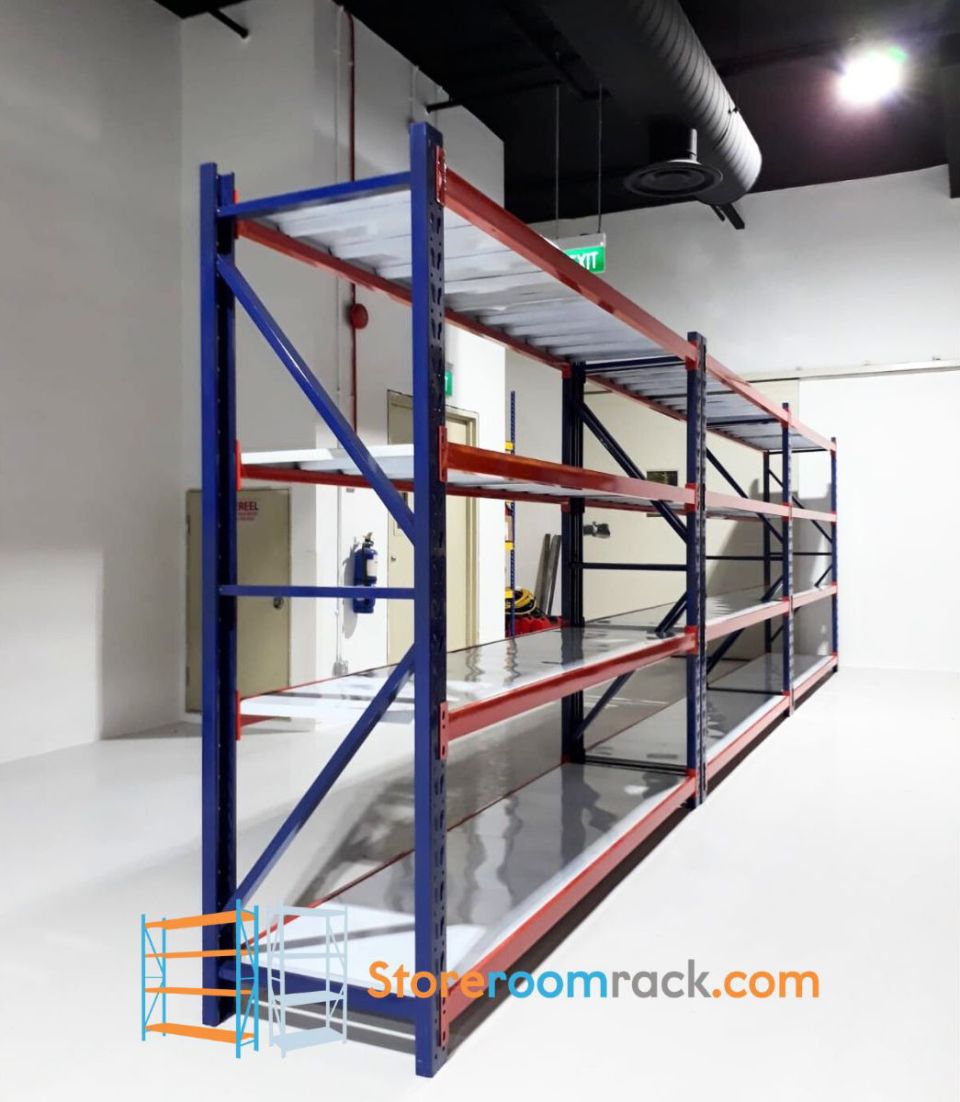
Buying a warehouse rack in Singapore looks simple until you start comparing quotes. One supplier talks about "heavy duty", another about "longspan", a third about "boltless", and the prices for what looks like the same steel frame can differ by half. This guide explains what actually matters — so you can compare like with like, and buy racking that still works when your business has doubled.
1. Start with the weight on one shelf, not the whole rack
The single most important number on any warehouse rack is its load rating per level: how much evenly-spread weight one shelf can carry. Our warehouse rack, for example, is rated at 400kg per level, while a lighter boltless office rack is typically 200kg per level.
To work out what you need, weigh a typical full carton and multiply by how many will sit on a shelf. Twelve cartons of 25kg is 300kg — comfortably inside a 400kg rating, but too much for a 200kg shelf. Always leave headroom: stock gets heavier over time, never lighter. We explain the maths in detail in load capacity explained.
2. Understand the three main types of warehouse racking
Most racking sold in Singapore falls into one of three families:
- Light-duty boltless shelving — up to around 200kg per level, short spans of 100–140cm. Ideal for offices, retail stockrooms and small parts.
- Medium-duty longspan racking — around 300–500kg per level, spans of 200cm and more, loaded by hand. This is what most SME warehouses, 3PL pick areas and central kitchens need.
- Selective pallet racking — a tonne or more per pallet position, loaded by forklift and anchored to the floor.
If nobody in your operation drives a forklift, you almost certainly need the first or second type. Our guide to industrial rack types compares them side by side.
3. Choose span and height from your floor plan
A longer span means fewer uprights in a run, which means fewer obstructions and slightly lower cost per metre of shelf. Our warehouse rack comes in 200cm and 245cm spans. A 245cm span suits wide cartons or long items; a 200cm span is easier to fit between pillars and doors.
Height is about your ceiling and your people. A 240cm frame adds a full shelf level in the same footprint as a 200cm frame — often the cheapest square footage you will ever buy — but the top level needs a step platform. Keep fast-moving goods between knee and shoulder height and use the top for overflow.
4. Plan the aisles before you order a single bay
Racks are only half of a warehouse; the other half is the space between them. As a starting point:
- around 90–100cm between facing racks for people carrying cartons;
- 100–120cm where pickers use trolleys;
- around 180cm or more where a manual pallet jack needs to turn into the aisle.
Fire-escape routes, exits, hose reels, sprinkler clearances and electrical DBs must stay clear. This is why we ask for a floor plan before quoting — see our step-by-step guide to planning a commercial racking layout.
5. Boltless or bolted?
Bolted racks are fixed from the day they go up. Boltless racks lock together with slotted uprights and hooked beams, so you can move a shelf level in seconds or relocate the whole bay when your lease ends. For a growing business in Singapore, where warehouse moves are common, that flexibility is worth a lot. We compare the two in boltless vs bolted shelving.
6. What a warehouse rack should cost
Comparing per-bay prices is misleading unless the specification matches. When you compare quotes, check that each one states:
- the load rating per level, and whether it is for evenly-distributed load;
- the exact height, span and depth;
- the number of shelf levels included, and the price of extra levels;
- the finish — powder coat lasts far longer than paint in Singapore humidity;
- whether delivery and installation are included, and at what times.
As a reference, our 400kg warehouse bays start from S$300 with two levels and are listed with their full price table on the product page. Delivery and installation are quoted per site, because a ground-floor unit with a roller shutter is a very different job from a high-rise unit with a booked goods lift.
7. Questions to ask any racking supplier in Singapore
- Is the load rating per level or per bay, and is it tested?
- Will you plan the layout from my floor plan?
- Do your own staff install, and can you work after hours?
- Can I add bays and levels later without replacing anything?
- What does the warranty cover, and for how long?
A supplier who answers all five clearly is one you can work with for years.
The short version
Pick the rack by the weight on one shelf, the span by your cartons, the height by your ceiling, and the layout by your floor plan. Get those four right and almost any warehouse rack in Singapore will serve you well — get them wrong and no brand will save you.
Planning racking for your business? Send us your floor plan and we will design the layout and quote it for free — usually within one working day.