Safety & loads
Metal Steel Rack Load Capacity Explained: What 200kg and 400kg per Level Mean
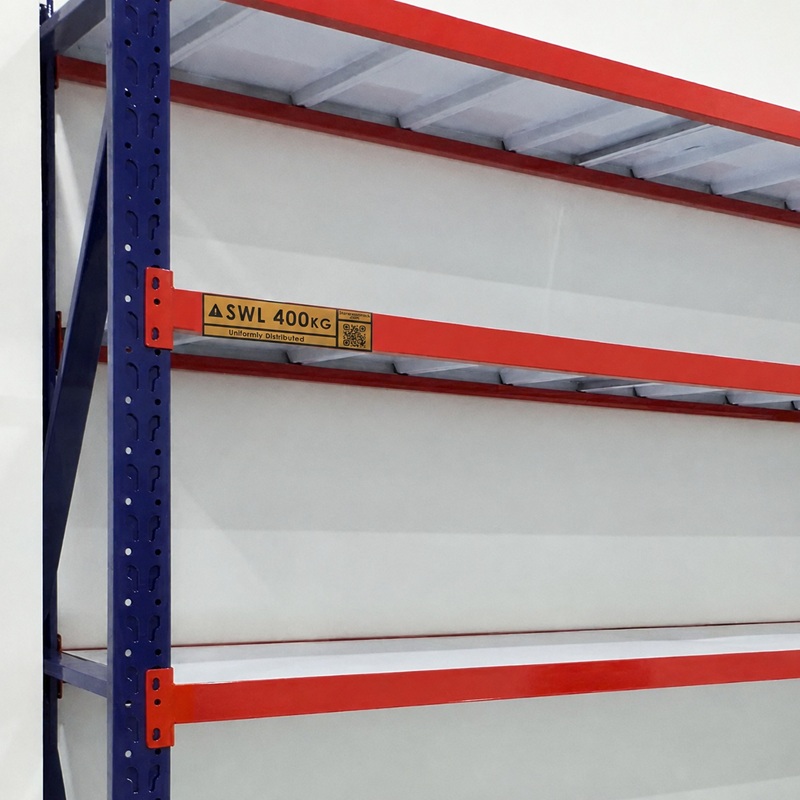
Every metal steel rack comes with a load rating, but the number is easy to misread. "400kg" on one supplier's sheet and "400kg" on another can mean completely different things. Here is how to read load ratings properly, with worked examples.
Per level vs per bay
A per-level rating is the maximum load on one shelf. A per-bay rating is the total for all shelves combined. Our warehouse rack is rated at 400kg per level; our boltless rack at 200kg per level. When comparing quotes, always ask which one you are being quoted — a "500kg rack" rated per bay is far weaker than a 400kg-per-level rack with four levels.
Evenly distributed vs point load
Ratings assume the load is uniformly distributed — spread evenly across the whole shelf. A single heavy object in the middle of a long span puts far more stress on the beams than the same weight spread out. Practical rules:
- spread heavy items across the full length of the shelf;
- put a single heavy item near the uprights, not mid-span;
- use the bottom level for the heaviest, most concentrated loads.
Worked example 1: cartons in a warehouse
You store cartons of 20kg each. A 200cm-wide shelf fits 12 cartons in a single layer: 12 × 20kg = 240kg. That is within a 400kg rating, with headroom. Stack them two high, and it becomes 480kg — over the limit. The fix: add another shelf level and keep the stacks single.
Worked example 2: an F&B dry store
Ten 10kg rice bags plus six 5kg oil tins on one 120cm shelf: 100kg + 30kg = 130kg. Comfortably within a 200kg boltless shelf.
Worked example 3: an office archive
A full archive box weighs roughly 10–15kg. Three per shelf is 45kg at most — a fraction of a 200kg rating. Paper is rarely the problem; people are, when they climb shelves to reach the top.
The loading mistakes that bend shelves
- Dropping loads onto a shelf instead of placing them — the impact can be several times the static weight.
- Pallet jack and trolley impacts on uprights at floor level.
- Climbing racks to reach the top shelf. Use a step platform.
- Uneven floors that twist a bay out of square.
- Removing a beam from a loaded bay to "make space".
Display the rating
A load label on each bay — the safe working load per level — reminds everyone of the limit. It is simple, cheap and one of the most effective safety measures in any store room.
Inspect regularly
Walk your racks every month. Look for bent beams, dented uprights, missing shelf panels or beams that are not fully seated. Unload and stop using any damaged bay until it is repaired.
Not sure which rating you need? Read our warehouse rack buying guide, or send us what you store via the free quote form and we will recommend the right rack.
Planning racking for your business? Send us your floor plan and we will design the layout and quote it for free — usually within one working day.